Funchal's Christmas lights are on from 1 December to 10 January, 41 nights of them, and the regional government signed off the design contracts back in March. Here is what is already confirmed for the 2026 season, where to stand to see it, and what the island is actually celebrating underneath all of it.
Forty-One Nights, From 1 December to 10 January
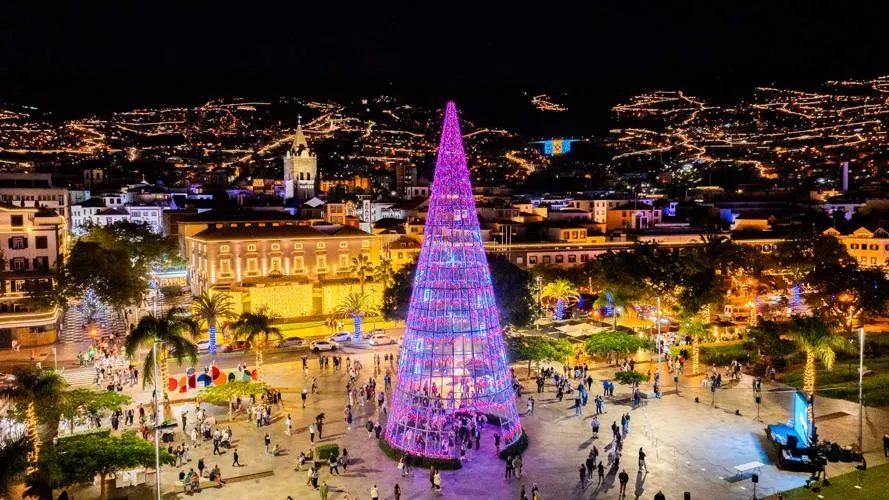
The official tourist entertainment calendar, published by the regional tourism department, puts the General Illumination of the Funchal Amphitheatre from 1 December 2026 to 10 January 2027, with the Christmas Exhibits in the downtown running across the same dates. That is 41 nights, closing on the Sunday after Epiphany, and the whole lit bowl of the city is the point rather than any single street.
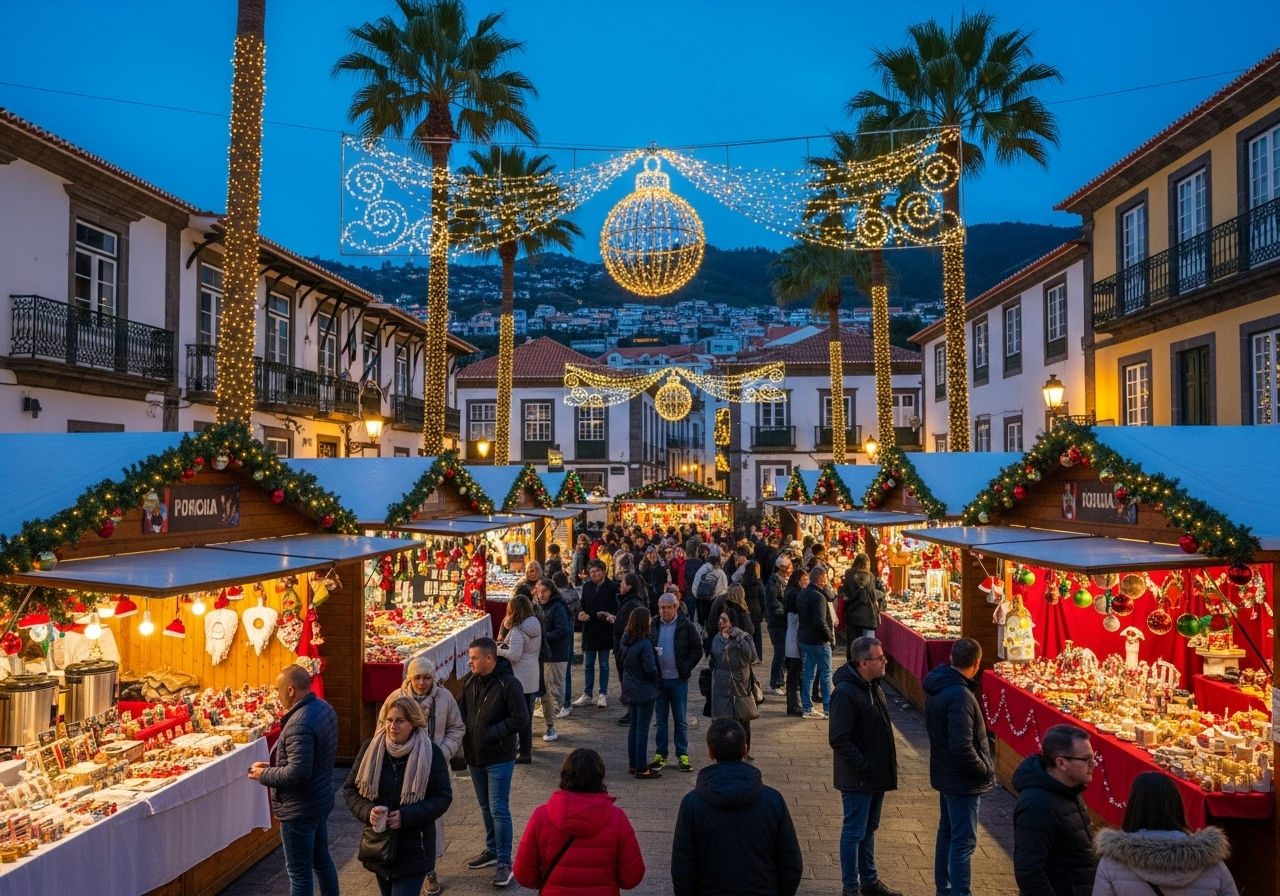
The island commits to this a long way out. On 31 March the Jornal Oficial carried three portarias releasing the budget for the decorative lighting design for the 2026/2027 and 2027/2028 seasons, split by patch of city: €401,247.00 for the central Funchal zone, €451,552.50 for the harbour front and €167,475.00 for Rua Fernão de Ornelas and the streets beside it. A little over €1.02 million across two winters, committed eight months ahead of the first night. Our page on the Funchal lights and market carries the day-by-day programme as the city publishes it.
The New Year Display Needs 59 Launch Points
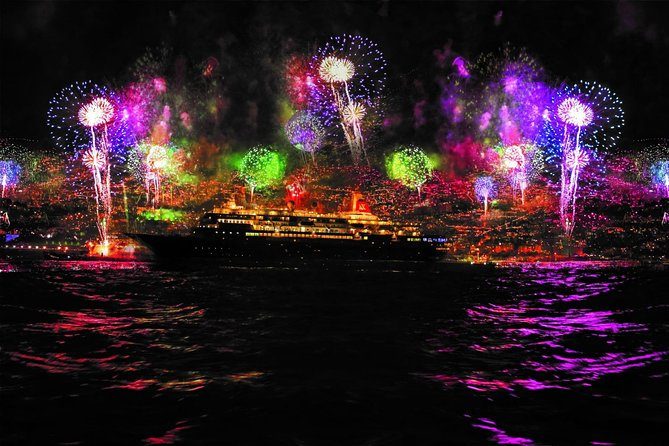
The fireworks over the bay are the other half of the season, and they were settled in the summer. A Council of Government resolution of 2 July set 59 launch posts across Madeira and Porto Santo for the 2026/2027 display at a cost of €1,212,696 plus VAT, as Diário de Notícias da Madeira reported. Twenty-seven of them sit in the Funchal amphitheatre itself, running from the Fortim do Lido round to Barreirinha and taking in São Martinho, the Tecnopolo, the Jardim Botânico, São Gonçalo and Pináculo.
Another 25 line the seafront between Cais 8 and the piers at Praia do Almirante Reis, and five are floating: three platforms south of the Molhe da Pontinha and two between Cais 8 and the Lazareto. Porto Santo takes the last two, at the Miradouro da Portela and the south end of the Cais Velho. Spread that wide, the display is not one point in the sky but the entire amphitheatre going up at once, which is exactly why it reads better from a distance than from directly underneath it. The date, as always, is 31 December.
Walk the Avenue, Then Get Above the City
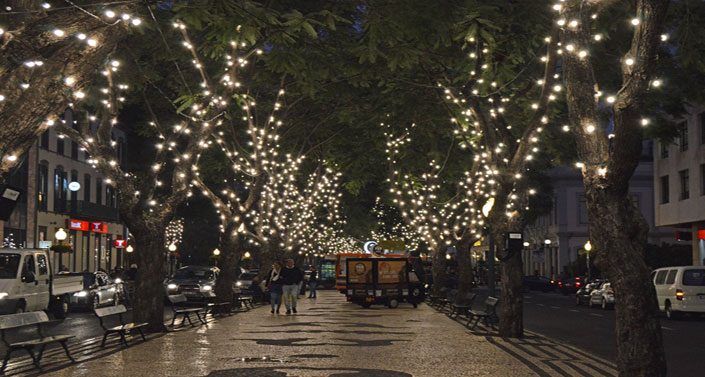
At ground level the downtown avenues do the work on their own: the trees go up in white light, the benches underneath stay busy until late, and it costs nothing to walk the length of it. This is the version most people photograph, and the one you can do on foot straight after dinner.
For the whole amphitheatre lit at once you need height, and two municipal viewpoints give it to you without a ticket. The Miradouro do Pico dos Barcelos, up in Santo António at about 355 m, looks straight down over the bay and has green space and stalls selling regional food and crafts. The Miradouro do Pináculo, at 283 m on Rua Conde Carvalhal, does the same job from the eastern side of the city.
Monte is the one to plan around rather than default to. The cable car runs 08:45 to 17:45 every day except Christmas Day, at €22 return, so the last car down leaves before there is anything lit to look at. Ride it in daylight for the view and the gardens, then come back down by road after dark, or drive up.
Under the Lights, a Season Built on Lapinhas and Dawn Masses
The nativity scene here is the lapinha, and it comes in two shapes. The escadinha is a three-step stand set on a table or a chest, covered with a red cloth and white linen, with the Menino Jesus at the top. The rochinha is the ambitious version: a painted paper landscape of mountains, valleys and a grotto that can take up a whole room, and the elaborate ones fill in village life around it. They tend to go up around 8 December now; they were once built only on Christmas Eve.
The other fixture is the Missas do Parto, nine masses in honour of the Virgin, one for each month of the pregnancy, from 16 to 24 December. They were held at dawn so farmers could get to them before work, roughly between 05:00 and 07:00, and in recent years at about 06:00. The part that matters is what happens after: the congregation comes out onto the church steps for hot drinks, home liqueurs and broas, and the whole thing turns into a street gathering while it is still dark.
The food follows the same logic. Carne de vinha d'alhos, pork steeped in wine and garlic, is the dish of the season, and the sweets are bolos de mel and broas de mel, broas de coco and rosquilhas. The liqueurs people are proudest of are tangerine, aniseed and caramel, and the good ones are made at home rather than bought.
What We Tell Guests Who Are Here in December
If you are on the island on 23 December, spend the night in town. That is Noite do Mercado, when the Mercado dos Lavradores and every street around it fills up, and the carols run in the Praça do Peixe from about 23:00 for roughly an hour. If you would rather see the market working than celebrating, go on a weekday morning instead: it opens 07:00 to 19:00 Monday to Friday and 07:00 to 14:00 on Saturday, and closes on Sundays and public holidays.
The other thing we tell people is that the season does not end when the flights home are booked. Cantar os Reis brings singers through the Municipal Gardens on 5 January, the official programme runs to 10 January, and several parishes keep going well past that. On the night of 14 January in Santa Cruz, Ponta do Sol and Paúl do Mar, groups go house to house with a broom and a shovel to finish off whatever sweets and drinks are left, the varrer os armários. Câmara de Lobos does not take the lapinha down until 20 January.
That is the useful thing to know about Christmas here: if you are still on the island in the middle of January, somebody down the road is still at it.